Showing posts with label Books. Show all posts

Wednesday, August 22, 2018

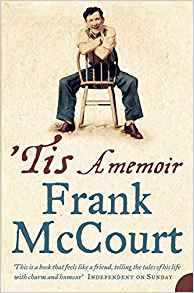
Tis

Tis
Frank McCourt
ISBN 0684865742

Every teacher has a book inside them. In some cases it is as well if it just stays there. In Frank McCourt’s case I can only say I am glad it came out into the open.

In prose a bit like a stream of consciousness, he writes about his life in Limerick and the problems of moving back to New York and trying to make headway against poverty and prejudice. So far so depressing but he manages to make it come alive and make it highly readable.

And then in the second half of the book is his life as a teacher. His description of his first lesson with a sassy New York class is a delightful and frightening evocation of the problems everyone encounters as an NQT. I can recommend it to anyone who has ever come into a classroom and found the pupils know how to handle the situation much better than they do!

He is very open about his feelings even when these are discreditable, especially when these are discreditable. He does not give himself the benefit of the doubt or cloud his emotions. When he wants to be extremely rude to his mother or father he gives his exact feelings but concedes that he didn’t actually say any of these hurtful things.

He compares being Irish and being expected to be interested in “irishness” with being black and expected to be interested in specifically “black issues.” He adds that at least he could (if he wanted) have changed his accent but not the colour of his skin.

(Grammatical note – my use of the word “they”is wrong as any English teacher will readily assert. However the Oxford English Dictionary (no less) acknowledges, perhaps reluctantly, that “they” can be used as a substitute for “he or she” where the latter would be clumsy.)

Every teacher will find something to like in this book


Amazon Author Page

Thursday, August 16, 2018

Two lives

Vikram Seth ISBN 0-316-72774-1


“Don’t take the black man” were the first words Henny Caro first said about Shanti Seth when he was proposed as a lodger in her family home – hardly a promising start to a relationship which was to last the rest of their lives.

Shanti and Henny Seth were not famous, at least prior to the publication of this book. Their lives spanned a fair proportion of the twentieth century and they were dominated and changed forever by the rise of Nazism and the second world war.

Shanti, born in 1908 and brought up in India, was sent to study dentistry in Berlin in the 1930s although he did not speak a word of German. It was there that he met Henny who came from a patriotic “intensely German” family. In addition to her initial hostility, she was also engaged to someone else.

She was able to get out of Germany and went to reside in London where they became close friends. He lost his arm at the battle of Monte Cassino but went on to pursue a successful career despite his disability. It was only after the war that she learned that her mother and sister died in Auschwitz. The book traces her search for the truth about their fate.

This close intimate portrayal of their lives by their nephew is a powerful work of art and will not leave any reader unmoved.

Interestingly as well as dealing in detail with the plight of the Jewish families in Berlin during the war it also deals with the less well-documented suffering of Germans in the post war period.

It also deals with the effect on Henny’s group of close friends in Berlin, Jewish and non Jewish, one of whom became an apologist for the Nazis. The personal is political in this novel but there is nothing but the most superficial of political analysis on the part of the writer; the reader has to provide that.

In addition to spanning the century, the narrative spans the globe, from India, Germany, Israel and Palestine to Britain where they lived most of their lives.

Reflecting on the story which he has been telling, the author concludes, “Behind every door in every ordinary street, in every hut in every ordinary village on this middling planet of a trivial star, such riches are to be found.”

Read it.


Amazon Author Page

Thursday, August 09, 2018

The Girl who kicked the Hornet's nest

The Girl who kicked the Hornet's nest
Steig Larsson
ISBN 978-1-84916-274-6

The Millenium Trilogy by Stieg Larsson is a fascinating series of books which deserves an audience beyond the devotees of crime fiction.

The girl of the title is Lisbeth Salander. She is a victim of horrifying childhood abuse at the hands of a respectable psychiatrist. She develops skills as a computer hacker which she uses to wage a campaign against men who torture women.

The 21st century slave trade – in which girls from the former USSR are duped into working as prostitutes in Sweden and subjected to rape and torture often by respected members of society – is one of the less-documented stories of the collapse of communism loudly trumpeted by the apologists of capitalism as “the end of history.” .

The books themselves develop as exciting detective dramas with a background in fact. They talk openly about the corruption at the very highest levels in Swedish society. The author was himself a campaigning journalist who exposed the dirty work of Swedish and international capitalism.

So it is hardly surprising that Salander's co-worker is the charismatic journalist Mikael Blomkvist. He is also portrayed as being irresistible to women. You might think this is a little wish fulfilment by Mr Larssen, I, of course, couldn't possibly comment.

The links between big business, the security services and neo-nazis are explicit in the books but all under the guise of fiction of course. Stieg Larsson himself met an untimely and unexpected death. Truth really can be stranger than
fiction!

The first two books “The Girl with the Dragon Tattoo” and “The Girl who played with fire” have been turned into excellent films and I for one look forward to the film
version of this one.


Journalism (noun)
telling a story the people in power do not want to be told. Anything else is just advertising.


Matter by Iain M Banks

Iain M Banks' Sci Fi novels novels are a romp through the ideas of Science Fiction – always interesting and always surprising. In that he resembles E E Doc Smith for the sheer exuberance of his writing. Fortunately he does not have Smith’s obsession with projectile weapons.

Banks’ novels often centre on a socialist society – known as “The Culture”. It is a society of abundance in which there is no poverty or war. "Matter" concerns how The Culture relates to the rest of the galaxy where war and poverty have not been abolished.


The Culture is a society where artificial intelligence has reached its highest expression and is regarded as equivalent to human beings – or vastly superior depending on your viewpoint! The wit and wisdom of the AIs and their relationship with the human members of the culture is part of the novel’s attraction.


The Shell Worlds are a theme of this novel. They are artificially created worlds which host a variety of life forms. One character from a shell world joins The Culture and then returns home to the relatively primitive society into which she was born when her father is assassinated. However in her absence she has become a member of the part of the Culture called “Special Circumstances” – an organisation of humans with enhanced powers. Special Circumstances alternately upholds and violates The Culture’s principle of non-interference with other life forms at every turn.

Instead of going back to grieve for her father she ends up with a mission to save the world. This is a book for science fiction fans and socialists. Iain M Banks is always good value for money.

Others

Others
James Herbert
ISBN: 0333761170

Whenever a mother has a child she hopes the baby is going to be OK, not the kind of person who will suffer a lifetime of pain and abuse and ostracism. Most babies, apart from an unfortunate tendency to look like Winston Churchill, are like that. Some have disabilities which attract sympathy. Then there are the “others” of the title.

James Herbert is a top horror writer and resides in Sussex (this novel is set mainly in a realistic and recognisable Brighton). I read horror stories when I was a young teenager because a good horror story (and that is what James Herbert writes) take the reader to a world where they can escape the ordinary. This book however locates the extraordinary firmly in the ordinary.

I won’t put in too many spoilers here but it is a fairly standard narrative. Why do evil doctors have this strange need to tell heroes all their plans before they make improbably inefficient attempts to kill them?

However the main theme of the novel is the way society treats “others” and of course Brighton is teeming with “others” of various kinds. It is not a book for the queasy and the kind of horrific description at which James Herbert excels is there in abundance. It is highly readable for people who like this genre.

I repeat the warning. To read it is easy but it is not for the queasy.

The book was first published in 1999 and is available in a large print edition. Avoid reading the blurb on the back of the book by the way because it gives rather more spoilers than I do

.

Wednesday, August 08, 2018

Space Dog Alfred Worksheets

These worksheets are also available on the TES website.

Space Dog Alfred 1

Space Dog Alfred 2

Space Dog Alfred 3

Space Dog Alfred 4

Space Dog Alfred 4 Answers

Space Dog Alfred  5 

You do not need to join Dropbox to download. The link takes you to Dropbox and you can just click on DOWNLOAD

https://smile.amazon.co.uk/Space-Dog-Alfred-space-adventure-ebook/dp/B0180Q6CJI/ref=sr_1_1?ie=UTF8&qid=1533749040&sr=8-1&keywords=space+dog+alfred


Friday, August 03, 2018

Forget you had a daughter

There is a clear implication in many of the books written about European or American prisoners in jails abroad that it is all very well for the "natives" to have to put up with disgusting conditions but it is just not cricket to expect us to.


For example, anyone who has read Midnight Express will have felt sympathetic to the protagonist but still felt, 1) he was a drug smuggler carrying an improbable amount of dope for his own use and 2) he seemed to have a contempt for the people and the country where he was imprisoned.

"Forget you had a daughter" by Sandra Gregory is the story of a drug smuggler who wound up in prison in Thailand and how she coped with the experience. She wound up in the infamous Lard Yao prison, jokingly referred to as the "Bangkok Hilton". If anyone begins this book thinking it is another "Midnight Express" they are soon disabused.


Sandra Gregory, who wrote the book with Michael Tierney, steers clear of that. The early chapters express her love for Thailand and the story ends with her regret that she can never go back there. She makes no bones about her guilt and/or stupidity. Moreover, she earned the disapprobation of some white prisoners because of her friendships with Thai prisoners and she has harsh words to say about the treatment of prisoners in British jails where she spent the last years of her sentence.

It doesn't sensationalise the sexual tension in a women's prison but doesn't skirt round it either.

The corruption in the prison was remarkable, prisoners could get most things on the black market but woe betide them if they couldn't pay their debts: "On one occasion a Nigerian woman had her bottom lip bitten off and fed to a cat, for not keeping up the repayments." I have to warn you that that is mild compared to some of the things reported in this book. It is not for those who are too fastidious.

Sandra Gregory is not obsessed with herself, throughout the book she observes and tells the stories of other prisoners. This is no sob story. Although it contains graphic descriptions of the conditions in prison it is written with some humour and is a very readable narrative.


Amazon Author Page

Saturday, January 15, 2011

Tucson shootings

The shootings of six people including a US senator a federal judge and a 9 year old child in Tucson sent a shock wave around the country and created a media storm. Everything in sight was blamed including the fact that not enough American politicians carry guns!

The deadly shooting in Tucson has not deterred a nearby gun show from continuing as scheduled exactly one week later. Organizers of the Crossroads of the West gun show say their event will proceed at a site just 13 miles from where the shooting took place. The gun show was moved to Pima County after Los Angeles officials decided organizers have promoted irresponsible gun use. Crossroads’ logo depicts a crosshairs inside the letter "O" of "gun show."

Palin has called it a "blood libel" that her extreme rhetoric is a factor in the violent attempt on one of her opponents. Palin has not been a shrinking violet when it comes to explicitly inciting the killing of political opponents.
For example she wrote about Julian Assange:

"First and foremost, what steps were taken to stop Wikileaks director Julian Assange from distributing this highly sensitive classified material especially after he had already published material not once but twice in the previous months? Assange is not a "journalist," any more than the "editor" of al Qaeda’s new English-language magazine Inspire is a "journalist." He is an anti-American operative with blood on his hands. His past posting of classified documents revealed the identity of more than 100 Afghan sources to the Taliban. Why was he not pursued with the same urgency we pursue al Qaeda and Taliban leaders?"


It's worth noting that there is no evidence that Assange has "blood on his hands." In a review of a previous round of leaks on Afghanistan, the Pentagon found no evidence that anyone had been endangered.

Palin having "blood on her hands" is a more apt figure of speech.
For the gun lobby in the USA it is an understatement.

Tuesday, July 01, 2008

Two Caravans by Marina Lewycka

This book tells the stories of a group of immigrant workers in the UK. The book switches point of view between the characters in a way which creates an original and exciting type of narrative.

As the novel develops it becomes the love story between Irina and Andriy. She is a devotee of the Orange revolution and westernisation in the Ukraine which she saw as a liberation from Russian domination. Andriy is the son of a miner who fought against the capitalist restoration and the consequent destruction of the mining industry.

Andriy is traumatised by a mining accident in which his father was buried underground. As the narrative develops it becomes clear that after the mines closed miners were forced to go underground without any safety precautions to get coal to use and sell. His grief turns into an anger against the “mobilfonmen” the spivs who have taken over the Ukraine and have their counterparts in the UK.

Irina's romanticism is gently mocked: 'English men are supposed to be incredibly romantic. There is a famous folk-legend of a man who braves death and climbs in through his lady's bedroom window just to bring her a box of chocolates.'

And the style of narration is an ideal way of showing how the two lovers misunderstand each other.

It would not be everybody’s choice to read a description of the appalling conditions of immigrant labour in the UK or the politics of the Ukraine but Marina Lewycka turns it into a tragic and comic narrative which is a good read.

And I leave the last word to Andriy “If I were a warrior, I would not be defending some stupid old stones but the flesh and blood of living people. In Donbas too the mobilfonmen have taken over, and people have become disposable, their precious lives thrown away through avoidable accidents and preventable disease, their misery blunted by vodka. This is the future his country has prepared for him - to be expendable. No he will not accept it."

The ISBN for this book is 978-0-670-91637-5. Get it from your library.

Sunday, March 11, 2007

Reading My Arse! By Ricky Tomlinson

Reading My Arse! By Ricky Tomlinson
Quick Read series publishes by Sphere
ISBN 978-0-7515-3953-0

“Searching for the Rock Island Line” is the subtitle of the book and really a more apt title because the one thing which comes across in this is Ricky Tomlinson’s love of reading.

He explains in the intro that when he was wrongfully imprisoned (he was one of the Shrewsbury Two imprisoned trade union organisers – many older readers will remember demonstrations and petitions calling for their release) he found reading was the one way in which he could "escape."

The story is about a young man’s search for the Rock Island line, both the railway line and the origins of the Lonnie Donniegan song. It is a positive paean of praise for the power of reading and its ability to transform people’s lives, to keep them from depression and even to help them in impressing their girlfriends.

Its combination of simple vocabulary and humour makes it a quick read, as the cover promises. Ricky Tomlinson comes across as a down-to-earth no-nonsense character capable of poking fun at himself and producing a highly readable book.

Friday, October 20, 2006

An Excellent Mystery

Although I don't usually review "whodunnits" (and look away now if you don't want to know!) Ellis Peters' books are interesting as an insight into aspects of medieval life - not least into the monk/pharmacist Cadfael's extensive knowledge of herbs.

The restrictions on Cadfael's knowledge which would come of him being a medieval monk are circumvented by his earlier life as a crusader and as a sea captain.

The only drawback in this novel is that everyone is just too nice to be true - even the villains. The way Peters deals with homosexuality in the monastery is at least sensitive although there is a bit of cheating (no I really will try not to give the plot away here).

However the book passes the test: it keeps the reader guessing (and wasn't I smug that I guessed aright!) and it is written with the economy of words which makes it readable but enough detail to make me want to read more Ellis Peters books.

Friday, October 06, 2006

Static by Amy and David Goodman

Static
Government Liars, Media Cheerleaders, and the People Who Fight Back
By Amy and David Goodman
ISBN: 1401302939
Published by Hyperion Books

Amy Goodman hosts the radio, TV program and website Democracy Now! which provides a platform for the voices of dissent in the United States. David Goodman is an award-winning investigative journalist.

I have to warn you that the first half of this book is worse than a nightmare because the stories it tells are true. Like the story of Maher Arar who was abducted by the FBI at JFK Airport on his way home to Canada, sent to Syria where he was put in a cell the size of a grave and tortured repeatedly and brutally.

Ironically when he was released without charge a year later, Bush made a speech denouncing the “Dictators in Iraq and Syria and their legacy of torture, oppression, misery and ruin.”

Horrific though it is, this is an excellent book for socialists to have to hand. It is full of facts and figures about issues from the systematic use of torture by the United States, media manipulation, the illegal surveillance of US citizens, the profiteering from war, denial of free speech and of course the horrors of the Iraq war itself.

However the second part of the book is inspiring. Beginning with Sindy Sheehan who set out to find out for what “noble cause” her son had died in Iraq the book gives example after example of people fighting back.

These are not always people with a fully-rounded political program. Many start out as pro-war until they see the realities for themselves. One was a man who joined the Marine Corps in 1999 as an artilleryman “to blow things up.” Now he leads anti-war protests.

Both as a source of facts and a source of inspiration this book is well worth buying. Or get your local library to get a copy so other people can share it.

Saturday, September 16, 2006

The Picture of Dorian Gray

The Picture of Dorian Gray
Oscar Wilde
ISBN 0745139302

Also available online here

It would be difficult to provide spoilers for this novel because most people know practically from the title the conceit of the narrative: Dorian Gray has his picture painted, the painting degenerates and ages while he retains his youthful good looks.

This is not a moral book although it is about morality. Victorian times were full of improving novels which would tell the reader to do good things and never do bad things. Unusually Oscar Wilde invites the reader to *think* about good and evil.

The main characters were all reflections of Wilde's personality. He had the same reputation as Lord Henry Wotton as a man who makes brilliant epigrams which are at variance with the moral dictums of the time.

He wanted to remain young and beautiful like Dorian Gray and he sought to be an artist in the field of literature as Basil Hallward is in the field of painting.

There is an astonishing homoerotic theme to the relationships given the Victorian world in which homosexuality was illegal and certainly no novelist could openly allude to it.

The victorian society was very like Dorian Gray with the appearance of innocence and the reality of corruption. Prostitution and drug addiction were rife in a society with apparently strict moral rules.